

From GitHub Specs to Product Experience
INTRO
Loopengers is a logistics app that helps truckers receive delivery requests, manage jobs, propose schedules, and track earnings. When I joined, the product existed primarily as a technical specification in GitHub Markdown—there were no wireframes, design system, or established visual language.
The team needed: complete user journeys, a clear UX foundation for development, and a practical interface that could turn technical requirements into something truckers could actually use.
As the sole product designer, I translated the documentation into complete user flows and around 150 screens, identified missing scenarios, designed edge cases, and collaborated with engineering throughout the process. I also adapted Snap&Go's existing design system to accelerate the mid-fidelity phase.
The product ultimately launched with a mid-fidelity UI, prioritizing complete flows, usability, and development speed over visual polish.
ROLE
Sole Product Designer, Freelance
STATUS
Shipped 2025
TEAM
Product Owner, PM, Engineers
TYPE
Startup, B2C/B2B, Mobile, Logistics, Web
TOOLS
Figma, ChatGPT, Claude, Framer
Problems
Loopengers involved deliveries, schedules, and customer communication across multiple steps. The challenge was making the workflow clear without overwhelming drivers with information.
Solution
I mapped the core journey, prioritized key actions and information, and translated the requirements into clear high-fidelity screens and reusable UI patterns.
Results
Loopengers had a more structured driver experience with clearer flows, stronger information hierarchy, and a visual foundation that could move into development with less ambiguity
Screenshot gallery


Process
DESIGN CHALLENGE
How do you turn a technical specification into a complete product experience when there are no designs to start from?
The requirements existed as short technical bullets, but they didn't describe the complete experience. I had to understand an unfamiliar logistics workflow, determine what was missing, and translate engineering requirements into something a trucker could actually use.
I leaned heavily on:
Technical documentation to understand product requirements
User flow mapping to turn individual requirements into complete journeys
Pattern research to understand unfamiliar logistics features
Edge-case thinking to define missing states and scenarios
Engineering collaboration to validate technical feasibility as requirements evolved
ISSUE #1
Complex delivery workflow
Drivers needed to accept deliveries, manage schedules, and communicate with customers through one app. The workflow contained multiple steps and states that could easily become confusing.
I mapped the end-to-end driver journey and structured the interface around the actions and information needed at each stage.

ISSUE #2
Too much information at once
Delivery details, schedules, status, and communication all competed for attention. The interface needed to provide enough information without overwhelming drivers.
I established a stronger information hierarchy, prioritizing critical delivery details and actions while moving secondary information out of the way.

ISSUE #3
Requirements and implementation were still evolving
The product was being developed while requirements and technical considerations were still evolving. The design needed to provide direction without creating unnecessary complexity for development.
I translated the requirements into high-fidelity screens and reusable UI patterns, while refining the experience as the flow became clearer.

Results
A complete logistics app that bridges the gap between engineering requirements and a practical, easy-to-use experience for truckers.
Starting with nothing more than a GitHub Markdown specification, I transformed fragmented technical requirements into a complete product experience that truckers can use in their daily workflow.
Beyond the MVP
Loopengers Website
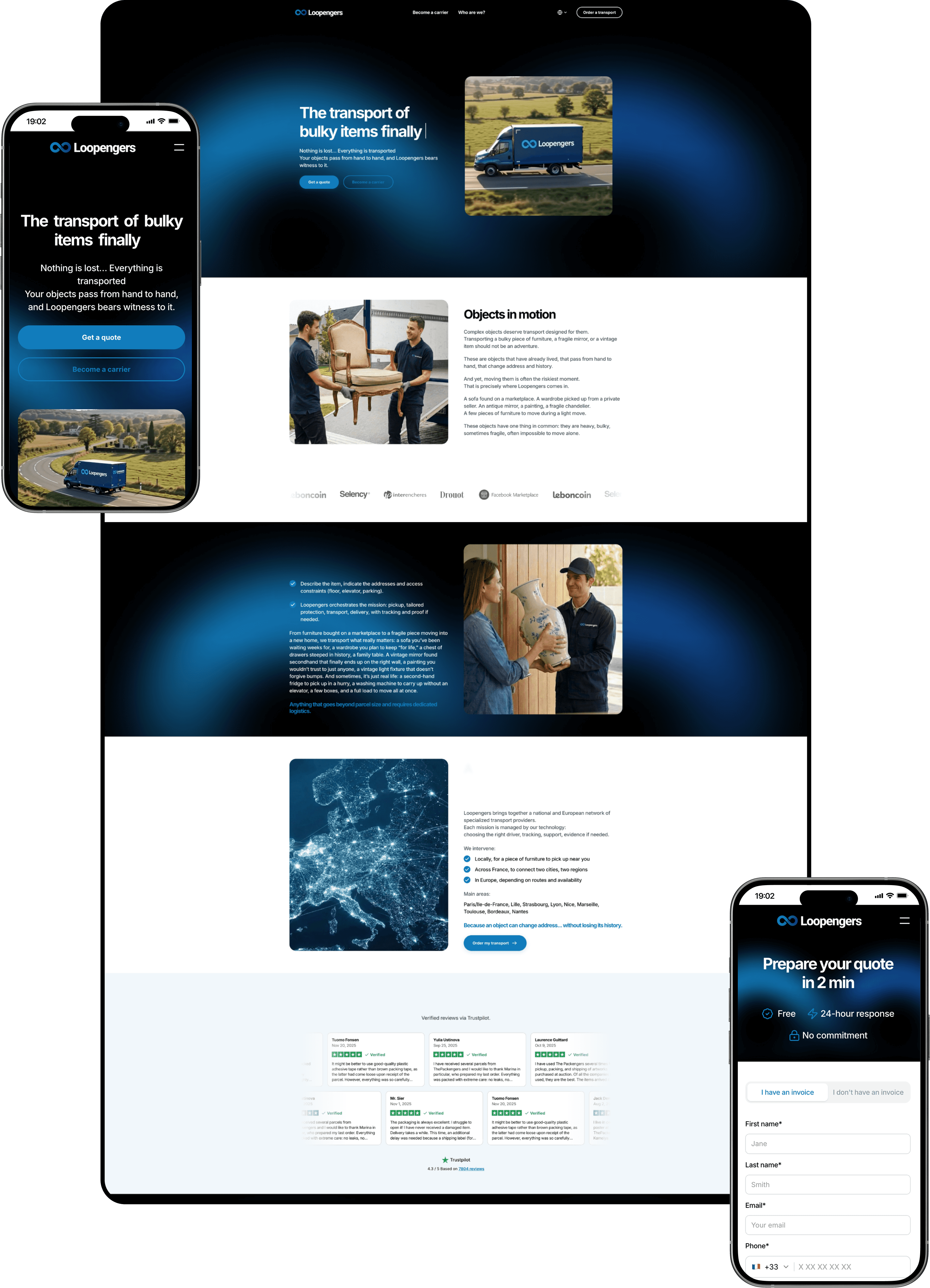
The MVP need a landing page for its launch. I designed and developed it solo in framer. I collaborated with the developers for the quote form integration. The result? A fully responsive website of 30+ pages with CMS built for their covered areas, item types, blog and platforms they partnered with. I collaborated with the backend to create the coded component for the quotation request, fully owning the front-end and UI, all built in less than 2 weeks.
What's Next?


